
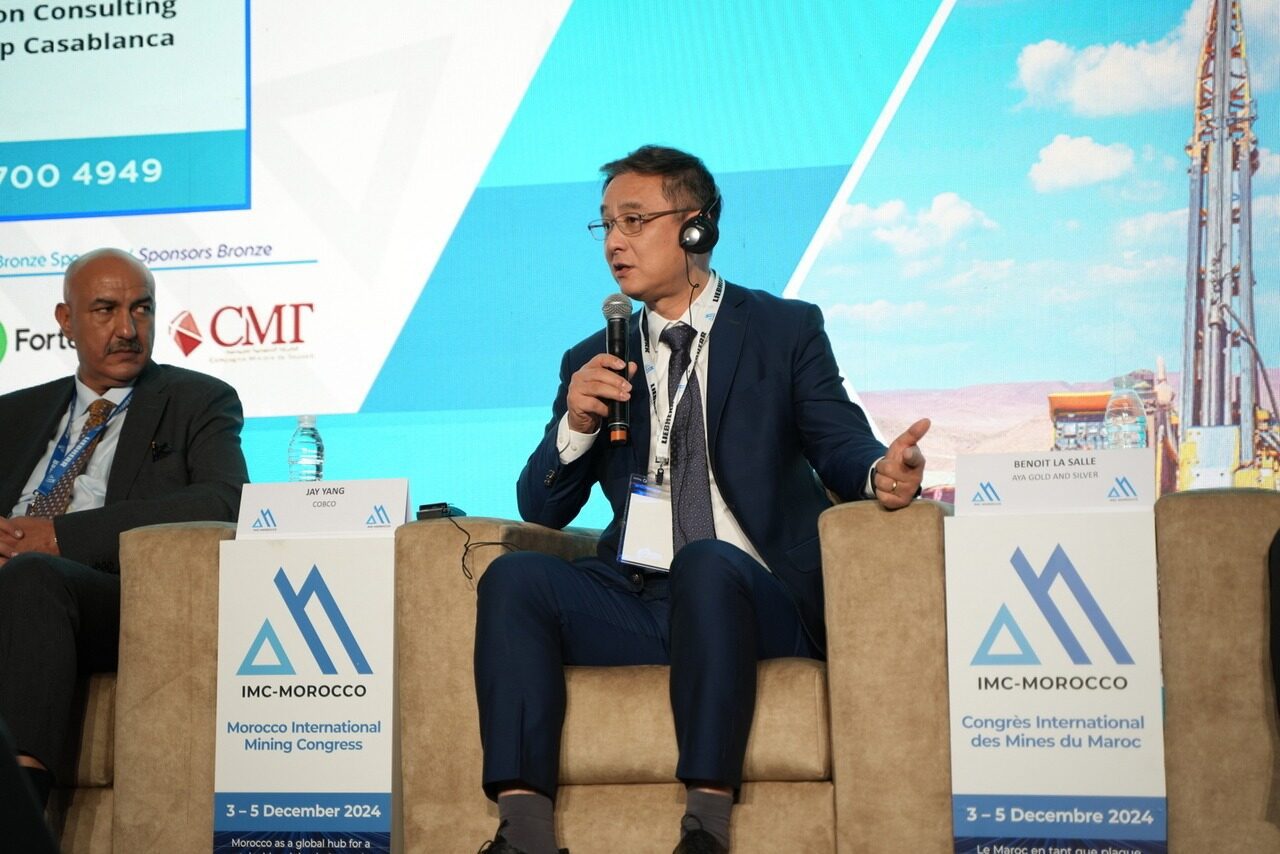
Marrakech, Morocco — The Federation of Mineral Industry of Morocco (FDIM) and AME Trade are pleased to announce the outstanding outcomes of Morocco International Mining Congress and Exhibition (IMC Morocco 2025), a landmark gathering that drew ministers, global mining CEOs, investors, industrial leaders, and technology experts from across Africa, the Middle East, and beyond. Over two strategic days, the congress reinforced Morocco’s role as an open industrial and technological hub for strategic and critical minerals, while advancing Africa’s unified ambition for mineral sovereignty, governance, value creation, and green industrial growth.
The event opened with a powerful address by H.E. Leila Benali, Minister of Energy Transition and Sustainable Development, who framed the global race for critical minerals within the tension between the slow timescale of geology and the rapid pace of global economic transformation. She emphasised Africa’s irreplaceable position in the global energy transition:
“Critical minerals have become the lifeblood of the 21st-century economy… and no one, absolutely no one, can move forward without Africa.”
She highlighted Morocco’s leadership in digitalising its cadastre, modernising its mining law, and pioneering new governance models for artisanal and small-scale mining, while praising the continental momentum behind the African ESG Framework and the OTC Corridor.
DAY 1 — SOVEREIGNTY, GOVERNANCE & DIVERSITY TAKE CENTRE STAGE
Day 1 set a strong political tone with the Ministerial Panel on Africa’s Integration into Global Mining Value Chains, where leaders from Morocco, Saudi Arabia, Mauritania, Liberia, Kenya, and Comoros explored the continental significance of the OTC Corridor. Discussions focused on sovereignty, African-led governance, resource traceability, and the need for harmonised ESG standards built by Africans for Africa.
A major highlight was the Women in Mining Leadership Dialogue, bringing together executives, policymakers, and rising professionals to address gender representation across the mining ecosystem. Speakers emphasised that Africa’s mineral future cannot be achieved without unlocking the talents of women in geology, engineering, finance, ESG, and policy. The session produced key recommendations on mentorship, career mobility, and gender-responsive workplace policies.
Technical sessions delved into critical minerals for the energy transition, showcasing Morocco’s growing importance as a regional processing hub for cobalt, phosphates, rare earths, and battery materials. Exploration innovation, upstream-downstream integration, and the continent’s long-term industrial sovereignty were central themes.
DAY 2 — LOGISTICS, INNOVATION & ESG SHAPE AFRICA’S INDUSTRIAL FUTURE
Day 2 shifted to operational excellence and the enablers of long-term competitiveness.
The Logistics & Industrial Corridors Forum examined the infrastructure backbone required to support Africa’s mineral ambitions—from ports and rail corridors to multimodal transport and certification platforms. Speakers emphasised that competitive logistics are essential for African countries to retain more value and integrate more deeply into global supply chains.
The ESG & Responsible Mining Forum provided clarity on the emerging African ESG Framework, developed collaboratively across multiple African capitals over the past year. Delegates welcomed the progress toward a shared African standard that is transparent, practical, and tailored to the realities of African geology, communities, and regulatory systems.
Innovation featured prominently through the Geometallurgy Roundtable, where experts presented advances in ore characterisation, AI-based resource modelling, and integrated mine-to-mill optimisation—tools that can reshape project economics and improve resource efficiency across African deposits.
Human capital was also addressed in depth during the Talent Development Session, which highlighted the urgency of training geologists, metallurgists, ESG specialists, data scientists, and processing engineers capable of driving Africa’s mineral-led industrialisation. Aligning academic curricula with digital mining, sustainability, and beneficiation emerged as pressing priorities.
Water stewardship—a critical challenge in Morocco and across many African regions—was explored through cases demonstrating advanced water recycling, desalination integration, and intelligent monitoring systems for operations in water-stressed environments.
A CONTINENTAL VISION MOVES FORWARD
A highlight of the congress was the collective momentum behind the forthcoming Marrakech Declaration—a landmark document expressing Africa’s unified principles for mineral sovereignty, responsible development, and continental value retention. Delegates reaffirmed that Africa must build its own value chains, define its own rules, and ensure its minerals benefit its people.
LOOKING AHEAD
FDIM and AME Trade extend their appreciation to all partners, ministers, industry leaders, and institutions that contributed to the success of IMC Morocco 2025. The event has once again demonstrated that Morocco is not only a convener, but a catalyst for Africa’s mining and industrial transformation.
IMC 2025 hosted 650+ attendees, 82 industry speakers, 15 sponsors, 74 exhibitors from 42 countries, and was full supported at the highest level by the Ministry of Energy Transition & Sustainable Development, the Ministry of Industry and Commerce, and AMDIE, the Moroccan Agency for Investment and Export Development.
IMC Morocco returns in 2026, continuing to advance investment, collaboration, and strategic alignment for Africa’s