
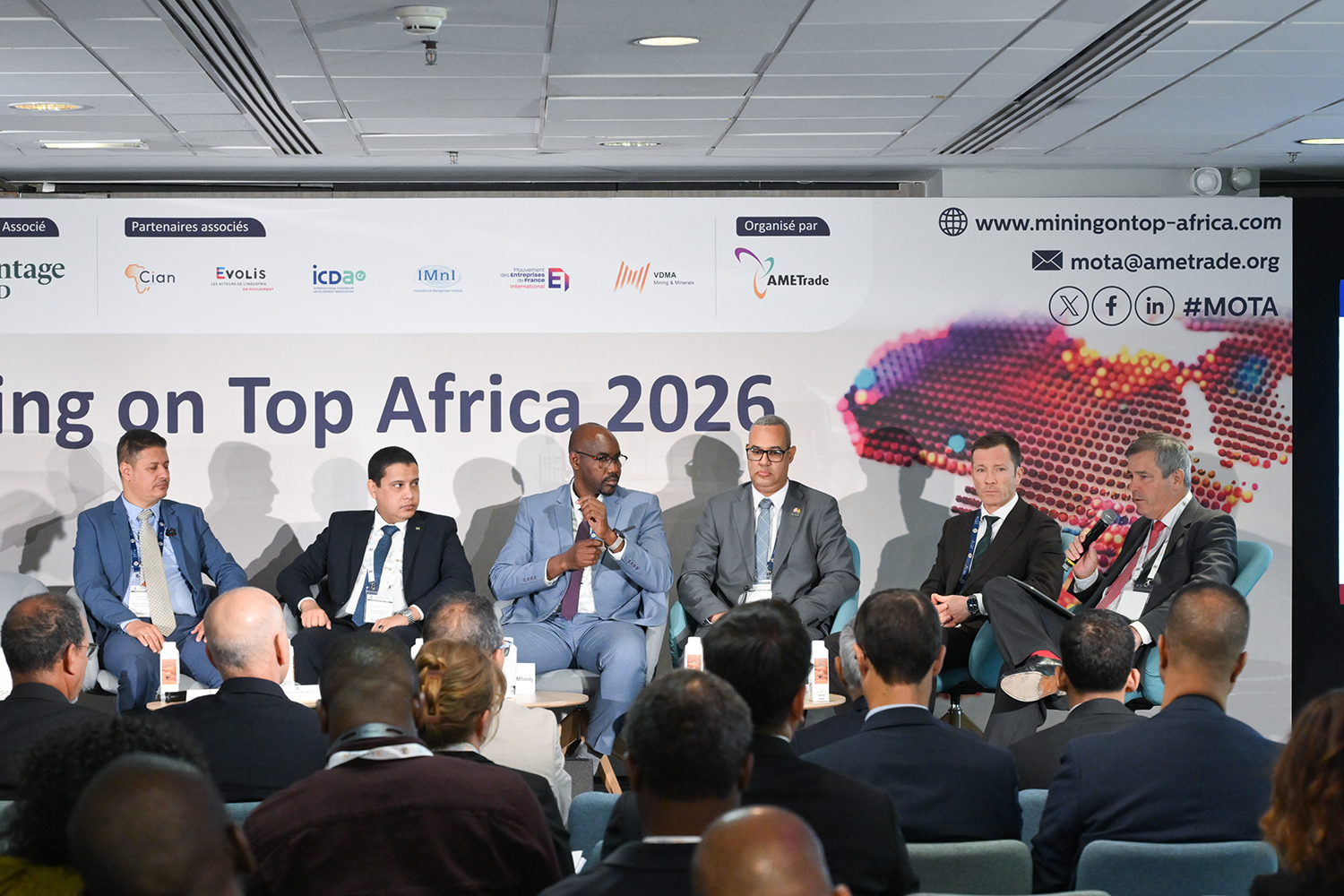
Paris, July 9, 2026 – Over two days, the plenary hall of the Paris Marriott Rive Gauche Hotel hosted a major event for the continent’s future: the 9th edition of Mining On Top Africa (MOTA 2026). Organized by AME Trade, the event brought together African ministerial delegations, financial institutions, and leading international mining companies (Montage Gold, First Quantum Minerals, Nimba Mining Company, Rio Tinto, Fortuna Mining, Aura Energy, Kamoa Copper, and Emiral Mining).
At the heart of this edition, under the theme “Securing Africa’s Mining Future: Sovereignty, Sustainability, and Global Partnerships”, the discussions established a fundamental paradigm shift, marking the definitive transition from a raw extraction model to a strategy of co-development, local value creation, and processing on the continent. Following the success of this unique business hub, the organizers officially announced its 10th anniversary edition, which will take place on July 7 and 8, 2027, in Paris.
The 2026 edition in a few key figures:
- 260 high-level participants from 32 countries.
- 5 high-level official delegations: Mauritania, Democratic Republic of the Congo, Senegal, Côte d’Ivoire, Ghana, and Guinea.
- 53 experts and decision-makers mobilized across 11 thematic working sessions.
“Mining On Top Africa is a neutral and highly strategic platform for dialogue, listening, and sharing, designed to allow you to align your economic visions,” noted AME Trade management during the opening speeches.
The conference opened under the moderation of Philippe Ngamou, featuring addresses by Talibouya Diagne (West Africa Regional Director, AME Trade), Jean-Luc Assi (Chairman of the Board, SODEMI), and Jean-Claude Guillaneau (PanAfGeo Coordinator and BRGM representative). The latter emphasized in his opening remarks that Africa is no longer on the periphery but stands firmly “at the center of global mineral transformation.”.
Chaired by Mariame-Yolande Bah from the ALSF, the ministerial roundtable immediately set the tone for the summit by bringing together key government leaders, including H.E. Edy Ould Zeine (Minister of Mines and Industry, Mauritania), H.E. Urbain Fiacre Opo (Minister of Mining Industries and Geology, Republic of the Congo), H.E. Yusif Sulemana (Deputy Minister, Ghana), and Secretary General Aboubacar Kourouma (Guinea).
The exchanges highlighted the continent’s absolute refusal to remain a simple global geological reservoir, choosing instead local industrialization:
- In Mauritania: H.E. Edy Ould Zeine stated that the national strategy relies on investor trust rather than legal coercion, announcing a plan to double clean electricity production within two years.
- In the Republic of the Congo: H.E. Urbain Fiacre Opo stressed the urgency of lifting logistical barriers with a clear formula: “extract, evacuate, process,” while committing the country to bringing a second potash company into production by the end of 2026.
During the working sessions, experts and financiers explored concrete solutions for the sector:
- Finance & Capital: Moderated by Stéphane Brabant, the session dedicated to financing (World Bank, AFC, DFC, IEA) highlighted the existence of $4 trillion in largely under-mobilized African domestic capital, prompting the moderator to remind operators that they must “dig into the law as much as into the ground.”
- Focus on Côte d’Ivoire: Moderated by Marie Badiane-Mbuyu, this panel (featuring SODEMI and Montage Gold) displayed a tenfold increase in investments over a decade. Montage Gold announced the first gold pour from the Koné project before the end of the year, backed by a secured capital of one billion dollars, while SODEMI reminded participants that there can be no sovereignty without baseline training and high-performance equipment.
- Focus on Guinea: Led by Hervé Theveniaut, the panel demonstrated national industrial maturity through the Simandou megaproject. Patrice L’Huillier (Nimba Mining Company) highlighted an operational ecosystem moving toward a 100% Guinean private enterprise, complemented by François Phopho Kamano, who excelled in explaining how the project’s rail and deep-water port infrastructures are already creating major opportunities for the agricultural sector.
- Europe & Global Partnerships: Jean-Claude Guillaneau analyzed the alignment of the European CRM Act and the $150 billion Global Gateway strategy, a session during which Christophe Thillier (ERAMET) stressed the urgent need to accelerate exploration using artificial intelligence.
The infrastructure and energy panel, animated by Yocoli Grace-Milca Konan, demonstrated that a project’s competitiveness depends on its social license to operate. Ekaterina Autet (IFC) warned that a mine cannot succeed without the support of local populations. Jed Benjamin Goldstein (First Quantum Minerals) raised the vulnerability of hydro-dependent systems to climate change, reiterating that the mine must primarily benefit the host country. Boubacar Ousmane Mbaye (Chamber of Mines of Senegal) added that “the future of the mining sector will come from what we build on the surface and not from what we extract from underground,” while Adrian Mill (ESS) recalled the purely financial dimension of ESG criteria.
The second day confirmed these structural shifts across critical minerals and gold :
- Critical Minerals: Louis Maréchal (OECD) warned that without immediate exploration and logistics efforts, there will be no mining projects tomorrow. Samuel Gahigi (Rio Tinto) asserted that Africa is becoming a consumer market and no longer just a source of supply, while Anass Joudy (EBRD) compared critical metals to the new oil, calling for strict value chain structuring.
- Gold Market: Kirill Kirilenko (CRU Group) noted a geopolitical shift: the yellow metal is moving from an export commodity status to a strategic sovereign reserve asset. Dr. Abdoul Karim Kabele Camara (Fortuna Mining) practically reminded the audience of the importance of economic attractiveness for business.
- DRC & Mauritania: The focus on Mauritania highlighted SNIM as the benchmark for successful local content. In the DRC, Popol Mabolia Yenga (Mining Cadastre) challenged Western decision-makers on environmental requirements, stating that “local efforts sometimes merely serve to clear the West’s conscience,” while Éric Kalala (Entreprise Générale de Cobalt) put human capital and post-mining transitions back at the center of the challenges.
In closing, the panel led by Sheraz Neffati (ICDA) and James Wallbank (Ibaera) sealed the summit with a crucial economic warning: local processing capacities must imperatively be established before enacting export bans. MOTA 2026 concluded with the clear statement that no global energy transition can occur without equitable territorial development.
The MOTA 2026 organization wishes to warmly thank all its sponsors, institutional partners, and associations for their renewed trust and essential technical contribution to the success of the event (Post Event… p. 3): Sponsors and Mining Companies: SODEMI, Fortuna Mining, Montage Gold, ALSF, First Quantum Minerals, Nimba Mining Company, Rio Tinto, Aura Energy, Kamoa Copper, and Emiral Mining; Partner Institutions & Associations: MEDEF International, VDMA, CIAN, ICDA, EVOLIS, and IMnI; Media Partners: Our sincere thanks go to our media partners, press networks, and specialized journalists for their coverage and indispensable commitment to promoting the challenges of the African mining sector.
See you at the 10th anniversary edition of MOTA, on July 7 and 8, 2027, in Paris. Email: mota@ametrade.org
Website: www.miningontop-africa.com
About AME TRADE Ltd
Founded in 2006, AME Trade Ltd has established itself as a leading player in facilitating trade and investment in African emerging markets. With over 20 years of experience, we specialize in sector- specific B2B events, conferences, and digital marketing services, notably in the fields of mining, energy, finance, and oil and gas. Operating in 29 African countries, we collaborate with leading industry experts and local SMEs to organize high-impact events that foster sustainable development and economic growth across the continent. Our mission is to facilitate meaningful business relationships, train, and bring together key stakeholders in order to address and resolve core issues for increased collaboration and progress in each business sector. Our presence on the ground provides us with a competitive advantage and unparalleled expertise. Our value-added service offering includes tailored training programs for capacity building, connected digital marketing services, and strategic business intelligence reports.
Join us in our efforts to shape a prosperous, sustainable, and inclusive economic development in Africa. To learn more, visit: www.ametrade.org Follow us on: LINKEDIN | TWITTER
For any inquiries, please contact:
AmeTrade Ltd
Head Office: 4 Devonshire Street, London, W1W 5DX T +44 207 700 4949 | www.ametrade.org
Media info, please contact us at: marketing@ametrade.org